How do I tell if I have pericoronitis?
You may have pericoronitis if the gum at the very back of your mouth is sore, red and swollen over a wisdom tooth that is only partly through, often with a bad taste, pain when you bite, or stiffness opening wide. A 2021 review in the International Journal of Environmental Research and Public Health puts its incidence at 4.92 percent, with 95 percent of cases around lower wisdom teeth.
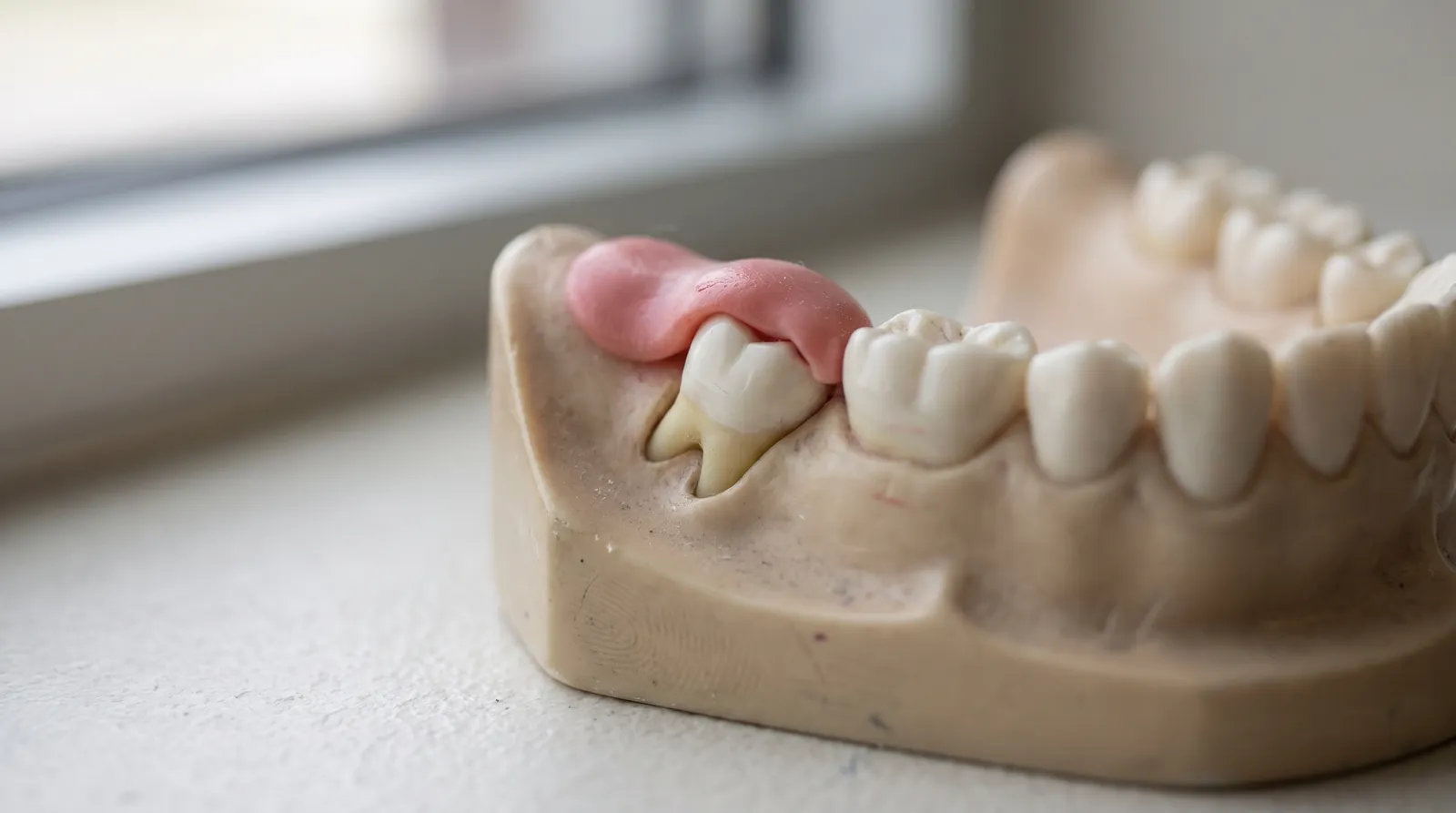
Pericoronitis is inflammation, usually with infection, of the gum around the crown of a tooth that has not fully come through. The operculum is the flap of gum that still covers part of that crown. Food and bacteria collect under it, out of reach of your toothbrush. The same review reports the highest incidence in people aged 20 to 29, the usual age for wisdom teeth to erupt, while children and adults over 40 are rarely affected.
The pain is often throbbing and can spread toward the throat, the ear or the jaw joint, so some people first think they have an earache. AAOMS lists tender or bleeding gums, red or swollen gums, jaw pain or swelling, bad breath or an unpleasant taste, and difficulty opening the mouth among the signs that can point to an infected wisdom tooth. A dry socket, an abscess on another tooth or a jaw joint problem can feel similar, so an exam confirms it.
What is the main cause of pericoronitis?
The main cause of pericoronitis is bacteria and food trapped under the gum flap of a partly erupted wisdom tooth, not a germ caught from someone else. Position matters: a 2019 meta-analysis of 21 studies and 6,895 patients in Archives of Oral Biology found that upright lower wisdom teeth had the highest odds of pericoronitis, and teeth sitting level with the molar in front had higher odds than those sitting lower.
An upright tooth that has partly come through tends to keep a flap of gum over the back of its crown, while the same meta-analysis found lower odds for a tooth lying on its side. The pooled studies varied widely, so treat the odds as a direction rather than a precise figure. Other factors can tip a quiet flap into a flare. The 2021 review describes the upper wisdom tooth biting down on a swollen flap, a recent cold or other upper respiratory infection, stress and smoking as factors linked to episodes.
Will pericoronitis go away on its own?
A pericoronitis flare can settle, and Cleveland Clinic says it may clear on its own when it flares while the tooth is still erupting. If the tooth cannot finish coming in, though, the flap stays and flares tend to return. In a 2026 Military Medicine service evaluation of 269 UK armed forces patients, most of those whose tooth was left in place had repeat episodes of pain.
Whether it returns depends on whether the tooth can finish erupting. The 2021 review explains that a flap over an erupting tooth is a normal stage that in most cases shrinks once the tooth meets the opposing tooth. If the tooth is stuck at an angle or has no room, the flap persists and flares again. In the UK military evaluation, 36 percent of patients had the tooth removed, partly removed or the flap cut away within five years of an urgent visit.
The evidence has limits: no good trial measures recurrence precisely, and the military figures come from a review of records. An older 2006 study in the British Journal of Oral and Maxillofacial Surgery followed impacted lower wisdom teeth that were left alone and found about one-third had to be removed within five years, and a past episode of pericoronitis did not predict which ones.
How do you treat a gum flap over a wisdom tooth?
Treatment for an inflamed gum flap over a wisdom tooth starts with cleaning: a dentist or oral surgeon flushes and gently cleans under the flap, drains any pus and shows you how to keep the area clean. The 2021 review says most cases resolve with this local care. Longer-term options are removing the flap or removing the tooth, chosen by tooth position and how often it flares.
An operculectomy is a minor procedure that cuts away the flap of gum over part of a wisdom tooth. A coronectomy is a partial removal that takes the crown and leaves the roots in place when they sit against the nerve; a 2024 review lists it alongside extraction and flap removal for pericoronitis. That review notes flap removal suits patients with good oral hygiene and a well-angled tooth, so it is a poor fit for a tilted tooth that will stay partly covered. Ask whether flap removal is an option for yours. Between visits, Cleveland Clinic lists warm salt water rinses among the home measures that can ease symptoms.
| Step | When it is used | Effect on the next flare |
|---|---|---|
| Cleaning under the flap, rinses, careful home care | First step for almost every flare | Settles most flares, but the flap remains, so it can return |
| Antibiotics, decided by your surgeon | Only with spreading infection or whole-body signs such as fever | Treats the spread; does not remove the flap that traps bacteria |
| Easing the bite of the upper wisdom tooth | When the upper tooth bites down on the swollen flap | Removes one trigger; the upper tooth is sometimes taken out |
| Removing the gum flap (operculectomy) | An upright tooth with room to come in fully and good hygiene | Clears the pocket if the tooth comes in fully; rechecked in case more tissue needs removing, with less pain than extraction |
| Removing the wisdom tooth | Repeat episodes, a tilted or stuck tooth, decay or a cyst | Removes the cause at that site; longer recovery and a small nerve risk |

Does pericoronitis need antibiotics?
Most pericoronitis does not need antibiotics. The 2021 review recommends local treatment first and reserves antibiotics for severe cases with spreading infection or systemic signs, yet found that almost 75 percent of surveyed dentists prescribed them for pericoronitis. A 2022 systematic review in the European Journal of Oral Sciences found no controlled trial of antibiotics for it at all. Your surgeon decides whether you need them.
The American Dental Association's 2019 guideline on antibiotics for dental pain and swelling covers infections from inside the tooth rather than gum flaps, but it sets the same principle: likely negligible benefit and potentially large harm, so antibiotics are for systemic involvement, such as fever or malaise, or a high risk of it. Antibiotics also do nothing about the flap itself, so a course that helps this week does not prevent the next flare. That decision belongs to the clinician who examines you.
Does a gum infection actually mean the wisdom tooth has to come out?
A gum infection around a wisdom tooth does not automatically mean the tooth must come out. NICE guidance from 2000 says a first episode, unless severe, is not by itself a reason for surgery, while a second or later episode is an appropriate reason. Removal makes sense sooner when the tooth cannot erupt fully, is decaying, or is harming the molar in front.
Keeping the tooth is reasonable when the flare was mild, the tooth is upright with room to come in, and you can keep the area clean. Removal is usually discussed when flares repeat or the tooth is tilted or stuck. The 2021 review adds that once removal is chosen as the definitive answer it should not be put off without reason, though whether to operate during an acute flare is still debated. If the roots sit close to the nerve, a 3D scan helps plan the approach.
Questions to ask your surgeon
- Is this tooth likely to come in fully, or will the flap stay?
- Is my upper wisdom tooth biting on the flap?
- Do I need antibiotics, or will cleaning and home care be enough this time?
- Is flap removal an option for my tooth's position, and could the flap grow back?
- If the tooth should come out, is it better done now or after the infection settles?
- How close are the roots to the nerve, and do I need a 3D scan?
Can pericoronitis make you sick, and when is it an emergency?
Pericoronitis can make you sick if the infection spreads beyond the gum into the deep spaces of the head and neck. The 2021 review lists fever, swollen glands on both sides, feeling generally unwell, trouble swallowing and limited mouth opening as warning signs of a more severe course. Trouble breathing or swallowing, or swelling spreading toward the eye or down the neck, means 911 or the emergency room.
Most flares stay local, so a sore flap alone is not a reason for alarm, but it is a reason not to wait one out at home for weeks. When you call, say when it started, whether you have a fever and when you last ate or drank, because treatment under IV sedation needs an empty stomach.
| What you notice | What it can mean | What to do |
|---|---|---|
| Sore, swollen flap, bad taste, food trapped, no fever | A local flare | Book a prompt visit and keep the area gently clean |
| Throbbing pain with gum or facial swelling, or a fever | Infection that may be spreading | Call the office today |
| Hard to open your mouth, swollen glands, feeling unwell | A more severe course | Call the office today; go to the ER if you can barely open |
| Swelling under the tongue or jaw, or spreading toward the eye or down the neck | A deep space infection | Go to the emergency room now |
| Trouble breathing or swallowing, or a change in your voice | A threat to the airway | Call 911 |
What does this look like at Greater Atlanta Oral & Facial Surgery when your gum is swollen?
At Greater Atlanta Oral & Facial Surgery, a swollen gum flap starts with a call to the Atlanta (Buckhead) or Cumming office. Describe what you feel and when it started, so Dr. Abtin Shahriari, the practice's only surgeon, can plan for your visit. If you have pain or an emergency, every attempt will be made to see you that day, and in many cases an infection can be drained at that same visit.
Dr. Abtin looks at the flap and the tooth under it, and a 3D cone beam CT scan may be taken when the roots, the bone or a hidden infection need a closer look. If the flare is mild and the tooth is likely to finish coming in, ask whether cleaning and home care are enough for now; whether you need antibiotics is decided after the exam. If the gum flap over a half-erupted tooth keeps getting infected, that is one of the listed reasons for wisdom teeth removal, and you can also ask whether flap removal is an option for your tooth.
Urgent treatment is often done with local anesthesia so it can happen quickly. If you would like IV sedation, mention your last meal and drink when you call, because it needs an empty stomach. Sometimes the infection is settled first and the tooth is dealt with at a planned later visit. For wisdom teeth, dental benefits often contribute, and an infection is one case where medical insurance may apply; the practice works with most dental and medical insurance plans for surgical care. If it is not urgent, request a consultation.
This guide is general information about oral surgery, not a diagnosis or a treatment plan. Your own options depend on an exam, your imaging and your health history, and they are set at your consultation. Contact the office with questions about your own care.