Impacted Canine Exposure in Atlanta & Cumming. A stuck canine, guided into place.
Impacted canine exposure is a minor surgery that uncovers an eyetooth trapped under the gum or bone so your orthodontist can bring it into line. You may need it if a canine has not come in on schedule, usually in the early teen years, and an X-ray or 3D scan shows it is blocked or tilted.
Who it is for
Who needs an impacted canine exposed
Most patients are teens referred by their orthodontist, though adults sometimes need it too. Your orthodontist and surgeon decide together whether the tooth can still be moved.
- A baby canine still in place well into the teen years
- A bump in the roof of the mouth or high above the front teeth
- An X-ray or scan showing the adult canine tilted or blocked
- Crowding that leaves no room for the canine to come in
- An extra tooth or growth sitting in the canine's path
- Space has been opened with braces and the tooth still has not appeared
How it works
How is an impacted canine uncovered?
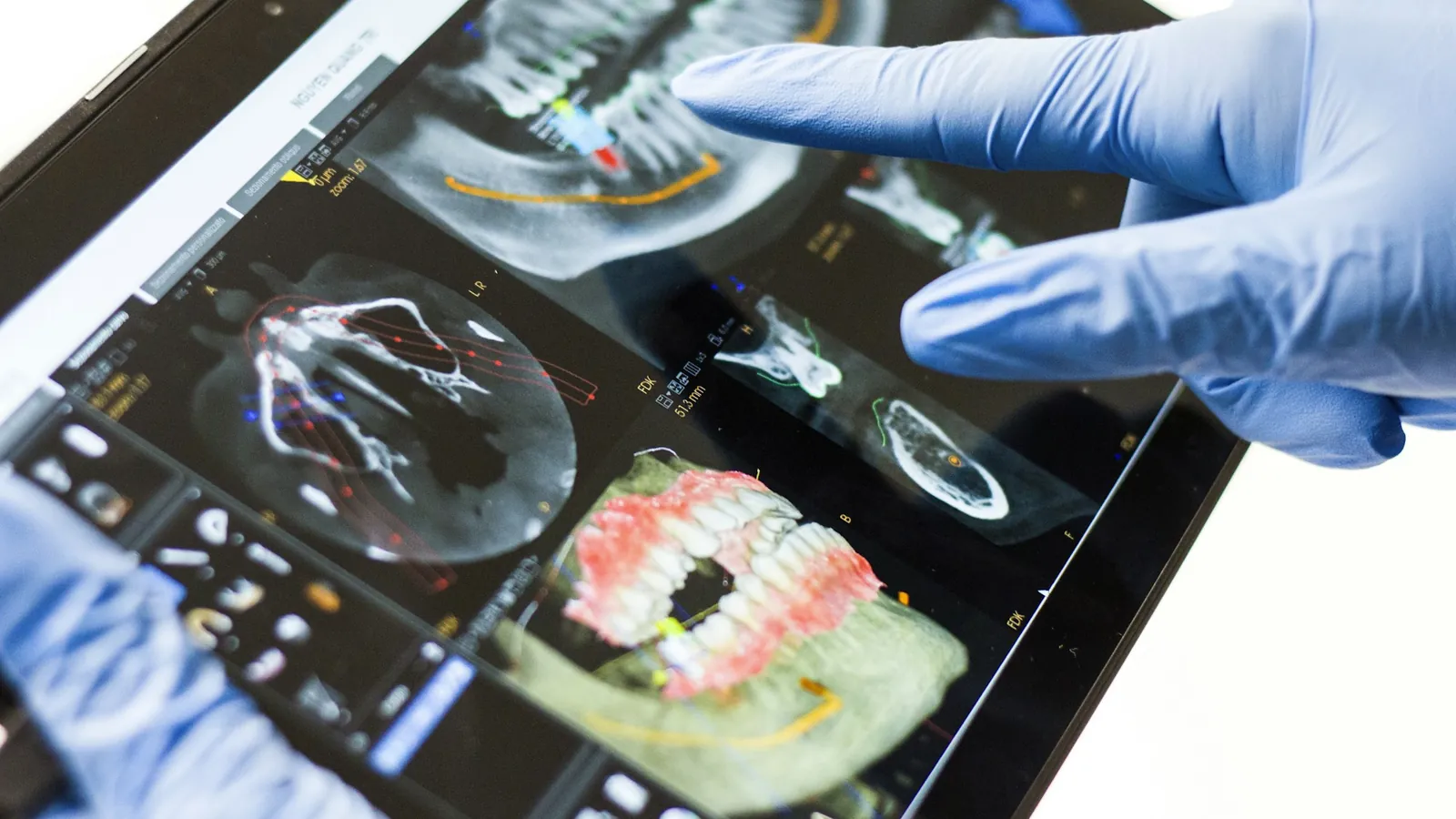
Dr. Abtin can use a 3D cone beam CT scan to see exactly where the tooth sits and how close it is to the neighboring roots. He times the surgery with your orthodontist, so the bracket goes on when the braces are ready to start pulling. Many teens have their wisdom teeth checked around the same years.
Orthodontist referral and 3D scan
Your orthodontist usually places braces first and makes room for the canine. At your consultation, X-rays, and a 3D cone beam CT scan when needed, show the tooth's position and angle.
Planning with your orthodontist
Dr. Abtin and your orthodontist agree on timing and on the direction the tooth should travel. That keeps the surgery and the braces working toward the same goal.
Exposure and bonding
Through a small opening in the gum, the surgeon uncovers the crown of the tooth and bonds a tiny bracket to it. A thin chain from the bracket is tied to your braces. A baby tooth still in the way is usually removed at the same visit.
Gradual eruption
Shortly after surgery, often within a couple of weeks, your orthodontist starts a light, steady pull on the chain. The tooth moves slowly on purpose, and the process can take many months.
Recovery
What is recovery like after canine exposure?
Most people feel sore for a few days and get back to school or work quickly. Your surgeon will give you written instructions for your specific case.
Expect some oozing and mild swelling. Rest, bite on gauze as directed and take medicine as your surgeon advised.
Soreness usually eases. Eat soft foods, rinse gently with warm salt water and try not to tug on the chain with your tongue or fingers.
Most patients are back to their normal routine. Brush carefully around the chain and keep the area clean.
Your orthodontist takes over and checks the tooth's progress at regular visits.
If the chain comes loose, bleeding does not slow down, or swelling grows after the third day, call the office. Questions are always welcome, even small ones. General after-surgery instructions.
What sedation is used for canine exposure?
Exposure is a short procedure, so many patients do well with local anesthesia alone or with laughing gas (nitrous oxide). Nervous teens, or cases where both canines are uncovered at once, may suit sedation options including IV sedation, and with IV sedation you can sleep through it. Dr. Abtin will go over the choices with you and a parent at the consultation.
About IV sedationDoes insurance cover impacted canine exposure?
Coverage for canine exposure depends on your plan. It is often billed to dental insurance, and some plans treat it as part of orthodontic care. Ask the team what your plan is likely to cover before surgery. Financing is available if you want to spread out your share.
Insurance and financingFAQ
Questions about impacted canine exposure
Direct answers first. Your consultation covers the details of your own case.
At what age is impacted canine exposure usually done?
It is usually done in the early to mid teen years, once braces have made room for the tooth. Upper canines normally come in around ages 11 to 13, so a late one is often noticed then. Adults can be treated too, but an older tooth is more likely to be fused to the bone and may not move.
Does canine exposure hurt?
Most patients feel pressure rather than pain during the procedure because the area is numbed first. You can add laughing gas or IV sedation if you prefer. Afterward, expect a few days of soreness that medicine usually keeps under control, along with mild swelling.
Why not just remove the impacted canine?
Keeping the canine is usually the goal because it plays a key role in your bite. Canines have long, strong roots and help guide your jaws as they close. Removing one leaves a gap that later needs a bridge or an implant, so extraction is generally saved for a tooth that cannot be moved.
How long does it take to move the canine into place?
It often takes several months to a year after surgery. Your orthodontist moves the tooth slowly with light force, which is gentler on the root and the surrounding bone. How far the tooth has to travel is the main factor in the timeline.
Do my orthodontist and oral surgeon work together?
Yes, coordination is built into the plan. Dr. Abtin works with your orthodontist on timing, bracket placement and the direction of pull, so you are not left carrying messages between offices. Both offices see the same goal: a canine that sits in line with your other teeth.
What happens if the canine will not move?
If a canine does not respond to the pull, it may be fused to the bone and need to be removed. Your surgeon and orthodontist will then talk with you about filling the space, often with an implant once growth is complete, or with a bridge.
Further reading
Patient information from health organizations
General education from independent sources. It does not replace advice about your own case.
- Expose and bondAmerican Association of Oral and Maxillofacial Surgeons
- When teeth are not coming inAmerican Association of Oral and Maxillofacial Surgeons
- Impacted toothMedlinePlus, U.S. National Library of Medicine
Related procedures
Often planned with impacted canine exposure
Tooth Extraction
Simple and surgical removal of damaged, infected or broken teeth, with socket grafting when you plan an implant later.
Wisdom Teeth Removal
Removal of impacted or problem wisdom teeth, planned from X-rays and a 3D scan when needed, with sedation options including IV sedation.
IV Sedation and Anesthesia
Local anesthesia, laughing gas and IV sedation, matched to your procedure, your health and how you feel.
Next step
Questions about impacted canines? Ask first.
Book online, or call the office closest to you. If you have pain or an emergency, every attempt will be made to see you that day.
Prefer we call you? Send a request
Monday to Friday, 7:00 AM to 5:00 PM. Closed Saturday and Sunday.