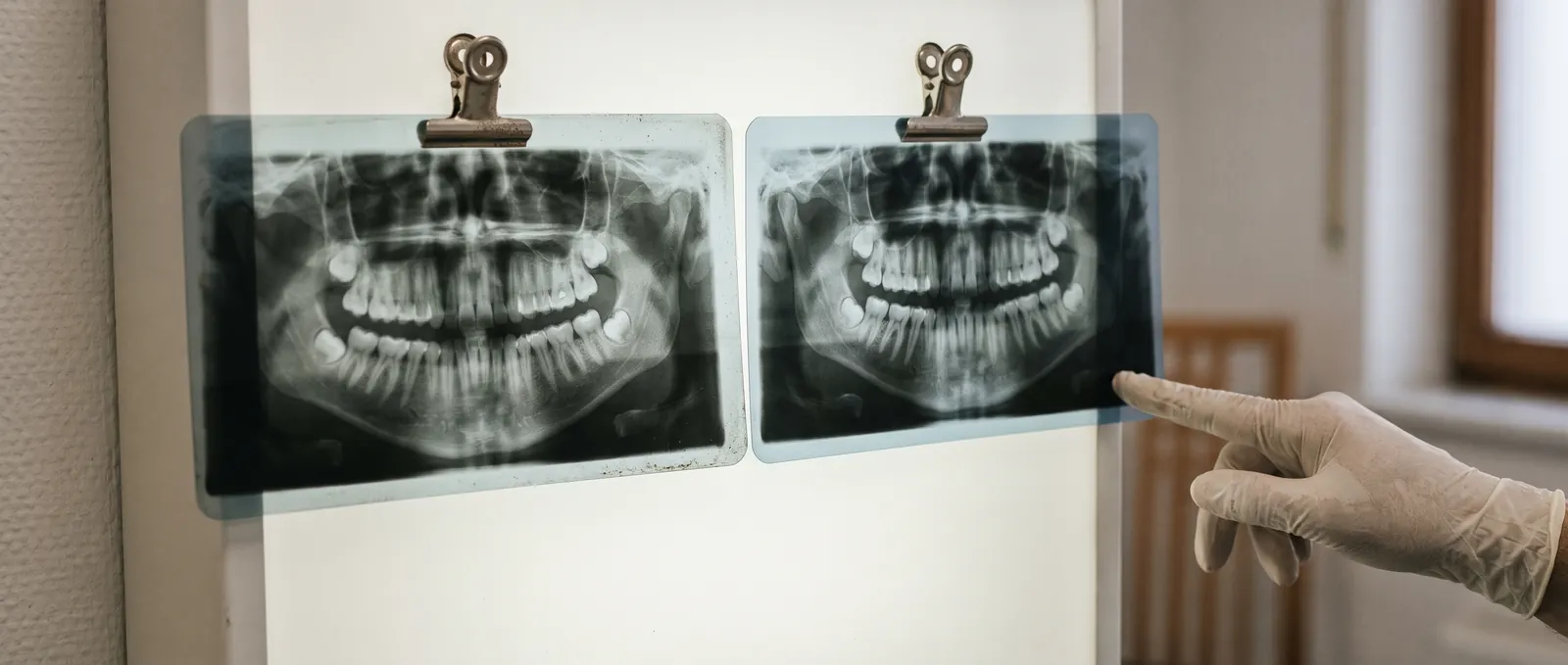
Can I leave my wisdom teeth in if they don't bother me?
Yes, you can often leave wisdom teeth in when they do not bother you, as long as they are also healthy. The American Association of Oral and Maxillofacial Surgeons (AAOMS) says wisdom teeth may not need extraction if they grow in completely and are functional, free of cavities and disease, and surrounded by healthy gum you can keep clean.
A wisdom tooth is a third molar, the last tooth at the back of each side of your upper and lower jaw, and it usually comes in between ages 17 and 25. An impacted wisdom tooth is one blocked by bone, gum or the tooth in front of it, so it stays partly or fully below the surface.
Comfort is a poor guide, because the main problems are quiet. Decay can start on the back of the molar in front, where you cannot see or feel it. On its monitoring page AAOMS says that having no pain does not mean having no disease. The NHS takes a more conservative line: a wisdom tooth that is not causing problems is usually left in place and checked at routine dental visits.
Is it healthier to remove wisdom teeth even if they don't hurt?
Research has not shown that removing healthy, symptom-free wisdom teeth makes people healthier. A 2020 Cochrane systematic review found only two eligible studies and concluded there is insufficient evidence to decide whether such teeth should be removed or kept. The reviewers advised shared decision-making and, for anyone who keeps them, clinical checks at regular intervals.
The two studies were a UK trial of 164 adolescents, 77 of them analyzed, and a US cohort of 416 men followed for 3 to more than 25 years. Neither measured quality of life, and certainty was low to very low. Very low-certainty evidence linked keeping the teeth to more gum disease on the second molar over time; for decay there was no clear difference, and nerve injury and repeat infections were not measured.
Guidance bodies read the same gap differently. England's National Institute for Health and Care Excellence (NICE) told the NHS in 2000 to stop routine preventive removal of impacted wisdom teeth that show no disease. AAOMS, the US specialty association, says that for many patients the question is when, not if. Your own X-rays and preferences carry real weight.
Should wisdom teeth be removed or not?
Whether wisdom teeth should be removed depends largely on how they sit and whether they are healthy. A 2025 meta-analysis of 13 studies and 13,788 patients in Clinical Oral Investigations found decay on the back of about 30 percent of second molars next to an impacted lower wisdom tooth, and on about 43 percent when the wisdom tooth tilted forward into it.
A 2013 Veterans Affairs cohort in the Journal of Dental Research followed 416 men for 25 years and compared new decay or gum disease on the molar in front with having no wisdom tooth at all; the table gives its figures by position. All were men, mostly middle-aged or older, so use the table as a starting point, not a verdict.
| How the wisdom tooth sits | What the research or guidance says | Plan usually discussed |
|---|---|---|
| Fully erupted, upright, healthy gum, easy to clean | AAOMS: may not need extraction while it stays functional and free of disease; VA cohort: still 1.74 times the risk to the molar in front | Keep, with cleanings, yearly checkups and periodic X-rays |
| Partly through the gum, or still covered only by gum | VA cohort: 4.88 times the risk to the molar in front for gum-covered teeth, the highest of any group | Removal often discussed, especially if the gum over it keeps getting infected |
| Tilted forward against the second molar | About 43 percent of second molars next to a forward-tilted tooth had decay in the 2025 meta-analysis | Removal usually discussed, sooner if the X-ray shows decay or bone loss in front |
| Fully in bone, no symptoms, no change on X-ray | Cochrane 2020: not enough evidence to favor removal or keeping; VA cohort: 2.16 times the risk to the molar in front | Often watched with periodic X-rays; a judgement call |
| Lower roots touching the nerve canal on a 3D scan | 2025 meta-analysis: removing only the crown (coronectomy) lowered nerve-injury risk | Watch if healthy; if it must come out, ask whether a coronectomy fits |
| Any position with unfixable decay, gum disease, repeated infection or a cyst | AAOMS, the ADA and NICE all list these as reasons for removal | Removal usually recommended |
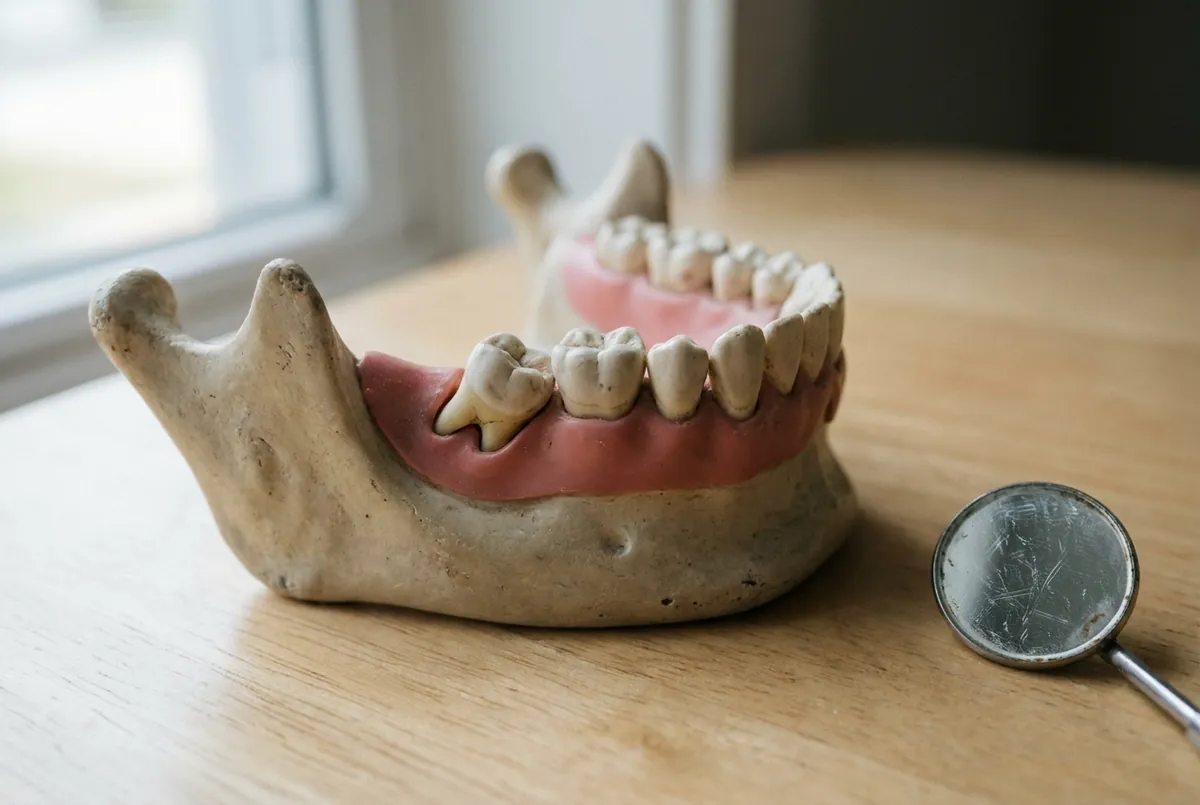
How long can I leave an impacted wisdom tooth?
An impacted wisdom tooth can stay as long as it stays healthy; there is no set deadline. Keeping one means monitoring it, not forgetting it. AAOMS lists three parts of proper monitoring: regular professional cleanings, annual checkups and periodic X-rays. The American Dental Association adds that the potential for problems still exists as you get older.
Watching a wisdom tooth is an active plan with clear triggers, and it has costs of its own: repeat X-rays, and the chance that a problem shows up later, when roots are fully formed. Monitoring usually looks like this:
- A starting X-ray that records the tooth's angle, depth and roots, so later films can be compared with it.
- An exam at regular dental visits, with the gum checked behind the second molar for a deepening pocket.
- Repeat X-rays at intervals your dentist sets, compared with the earlier film for decay, bone loss or a change around the crown.
- Home care at the back corner, noticing whether flossing between the last two teeth gets harder.
- A prompt recheck for pain, swelling, a bad taste, a gum infection or any new finding on X-ray.
How old is too late for wisdom teeth removal?
No age is too late for wisdom teeth removal when there is a reason for it, though risk tends to climb with age. In the AAOMS Age-Related Third Molar Study of 4,004 patients, published in 2007 in the Journal of Oral and Maxillofacial Surgery, being older than 25 was linked to 1.5 times the odds of complications. A smaller 2024 study using a 30-year cut-off found no difference in complications.
The case for earlier removal is practical. The 2020 Cochrane review notes that when wisdom teeth are removed in older people, the risk of complications, pain and discomfort goes up. In the 2007 study, 19 percent of patients had at least one complication of any kind, and age over 25 stayed a risk factor after other factors were accounted for. Only 6 percent of its patients were 25 or younger.
The evidence is not one-sided. The 2024 study of 200 patients and 554 impacted wisdom teeth in Clinical Oral Investigations, only 52 of them aged 30 or older, found no significant difference in nerve numbness, bleeding or infection between the two age groups. A tooth that has stayed stable on years of X-rays gives fewer reasons to operate, while new decay, infection or a cyst is a reason at any age.
What are the potential downsides of removing wisdom teeth?
The main downsides of removing wisdom teeth are a few days of swelling and soreness, a small chance of dry socket, and an uncommon risk of nerve injury. AAOMS puts dry socket at about 4 percent of all extractions and says numbness lasting beyond a short period is uncommon and usually temporary. Upper wisdom teeth near the sinus carry a separate, small risk.
Two nerves near the lower wisdom teeth supply the lower lip, chin and side of the tongue. A coronectomy is a procedure that removes the crown of a lower wisdom tooth and leaves the roots in place so the nerve beside them is not disturbed. A 2025 meta-analysis of 34 observational studies and 7,115 teeth in the Journal of Oral and Maxillofacial Surgery found it lowered nerve-injury risk compared with full removal, though 3.63 percent of coronectomy cases needed a second surgery. Because removal has these costs, keeping wisdom teeth, with monitoring, is usually the sensible default for:
- Teeth that are fully erupted, upright, easy to clean and healthy on exam and X-ray
- Deeply buried teeth that have stayed unchanged on repeat X-rays for years, especially in older adults
- Lower teeth whose roots touch the nerve, when nothing is wrong and surgery would add risk without solving a problem
- People whose medical condition or treatment makes elective surgery riskier, a point to raise with your physician and surgeon
Why are dentists so eager to remove wisdom teeth?
Dentists and oral surgeons often recommend wisdom teeth removal because they treat the late problems these teeth cause, and because surgery tends to be simpler in young adults. The 2020 Cochrane review shows research cannot settle the question for healthy teeth, so for those, removal is a judgement call. Asking what your X-ray shows, and what happens if you wait, is fair.
Clinicians mostly see the wisdom teeth that went wrong: the infected gum flap, the decayed second molar, the cyst found late. A good recommendation is specific. It names the tooth, points to something on the image, such as decay in front or a tooth tilted into its neighbor, and explains what waiting would look like. A vague answer is a reason to ask more, and a second opinion is reasonable before any planned surgery.
Questions to ask your surgeon
- Which wisdom teeth do you recommend removing, and what on my exam or X-ray is the reason for each?
- Is there decay, bone loss or a gum pocket on the molar in front?
- What would happen if we monitored it for another year instead?
- How close are the roots to the nerve or sinus, and do I need a 3D scan?
- If the roots sit against the nerve, is a coronectomy an option?
- If I keep them, who checks them, and how often should they be X-rayed?
What are the symptoms of a wisdom tooth infection, and when should you call right away?
A wisdom tooth infection usually shows up as pain and swelling at the back of the mouth, a bad taste or smell, tender gum over a partly erupted tooth, and sometimes stiffness when you open wide. Call your dentist or oral surgeon promptly. Call 911 or go to an emergency room for trouble breathing or swallowing, or swelling spreading toward your eye or down your neck.
Many wisdom tooth infections start in the gum flap over a tooth that is only partly through, a condition called pericoronitis. If you have pain or an emergency, every attempt will be made to see you that day at the Atlanta (Buckhead) or Cumming office, and the emergency oral surgery page explains what happens when you call. Use this list:
- Call 911 or go to the nearest emergency room: you are struggling to breathe or swallow, or swelling is moving toward your eye or down into your neck.
- Call the office today: swelling of the gum or face with a throbbing ache, a fever, or pain that keeps getting worse.
- Book a prompt check: a bad taste that keeps returning, food packing behind the last molar, or gum that bleeds whenever you brush there.
What does this look like at Greater Atlanta Oral & Facial Surgery, from first visit to plan?
At Greater Atlanta Oral & Facial Surgery, the decision starts with a consultation with Dr. Abtin Shahriari, the practice's only surgeon. He goes over your health and dental history, checks your mouth and jaw, and walks through your X-rays with you, adding a 3D cone beam CT scan when a root sits close to the nerve or sinus. Surgery is booked only after you have seen your own images.
Most of the consultation is spent listening to what bothers you and what worries you. If your images show a healthy, upright tooth you can keep clean, watching it may be the reasonable plan, and you return to your general dentist for routine care. If they show decay on the molar in front, a gum flap that keeps getting infected or a cyst, you talk through which teeth should come out, then choose a comfort option from local anesthesia to IV sedation.
For your first visit, bring a list of your medications, any referral slip from your dentist, recent X-rays and both insurance cards, or ask your dentist to send a referral. You can be seen at the Atlanta (Buckhead) or Cumming office, and the practice works with most dental and medical insurance plans for surgical care. When you are ready, book a consultation, or read the wisdom teeth removal page.
This guide is general information about oral surgery, not a diagnosis or a treatment plan. Your own options depend on an exam, your imaging and your health history, and they are set at your consultation. Contact the office with questions about your own care.