How rare is an impacted canine?
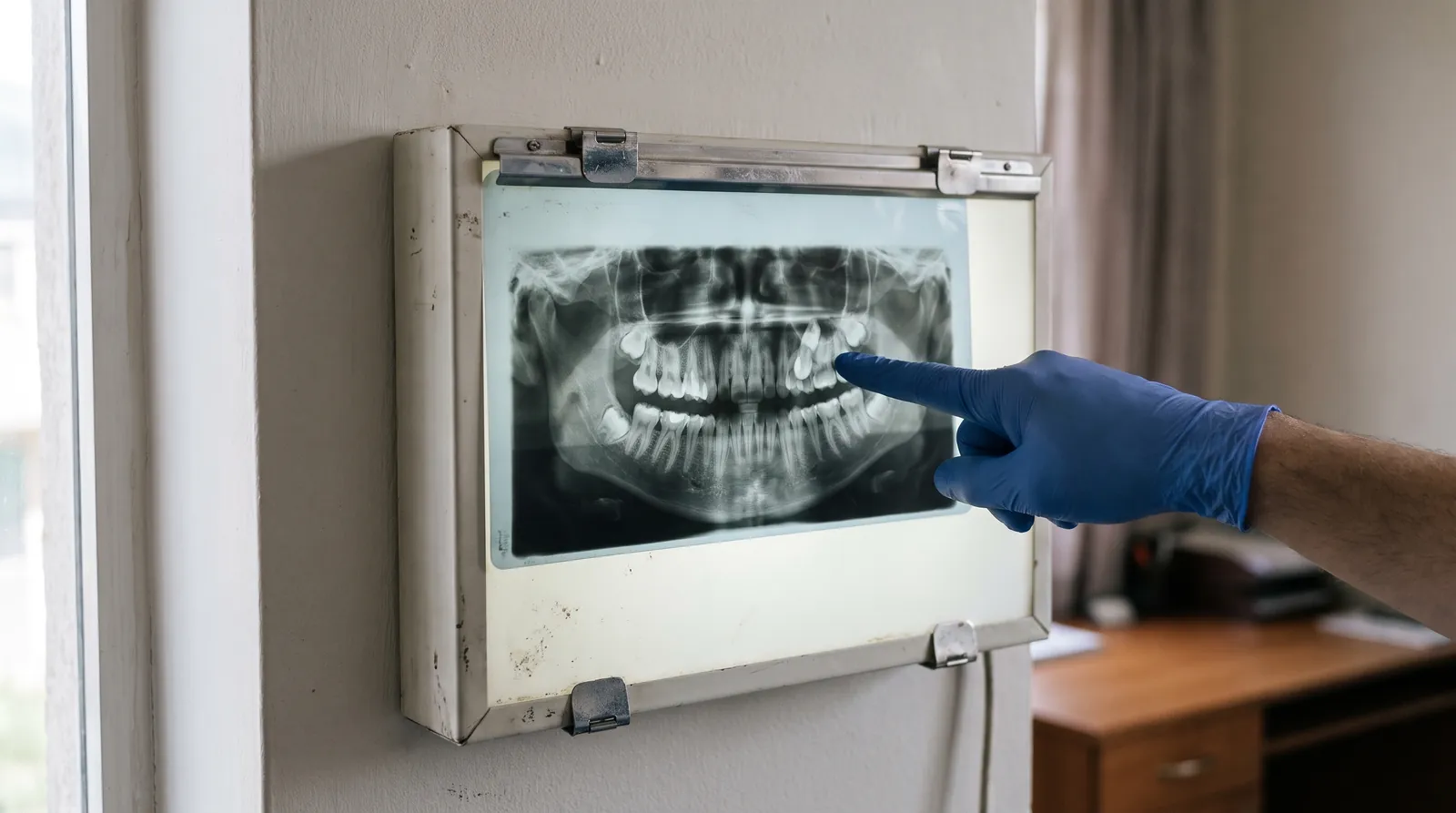
An impacted canine is uncommon but not rare. A 2026 systematic review of 31 studies in Medicina reported upper canine impaction in 0.97% to 7.10% of people, depending on the population studied, and notes that canines are the second most often impacted teeth after wisdom teeth. Lower canines are impacted less often than upper ones.
An impacted canine is an adult eyetooth that has not broken through the gum and is unlikely to come in by itself, usually because it is tilted, blocked or growing in the wrong place. Upper canines normally erupt between ages 11 and 12, according to the American Dental Association eruption chart, so a canine still missing in the early teens is a common reason for a closer look with an X-ray.
What causes impacted canines?
Impacted canines usually have local causes in the mouth. The 2026 Medicina review lists baby canines that stay in too long, a narrow upper arch, extra teeth, small benign growths called odontomas, and inherited patterns such as a missing lateral incisor next to the canine. The review concluded that genes play a secondary role to these local factors.
The American Association of Orthodontists advises a first check-up with an orthodontist by age 7 and notes that losing baby teeth too early or too late can cause problems for the adult teeth that follow. A baby canine that stays firmly in place while the other baby teeth are gone is one of those clues, which is why an early exam is worth having.
How do they fix an impacted canine?
An impacted canine is fixed in steps, from least to most involved: removing the baby canine early so the adult tooth can find its own way, making room with braces, surgically uncovering the tooth so braces can pull it into line (expose and bond), and removing the canine only if it cannot be moved. Age and the tooth's exact position decide which step fits.
Removing the baby canine is the earliest option. A 2017 systematic review of 4 randomized trials in The Angle Orthodontist found the displaced canine came in by itself in 50% to 69% of children after the baby canine was removed, against 36% to 42% without it. A 2018 meta-analysis in the European Journal of Orthodontics saw that benefit only after 12 months, so this route needs patience and follow-up X-rays.
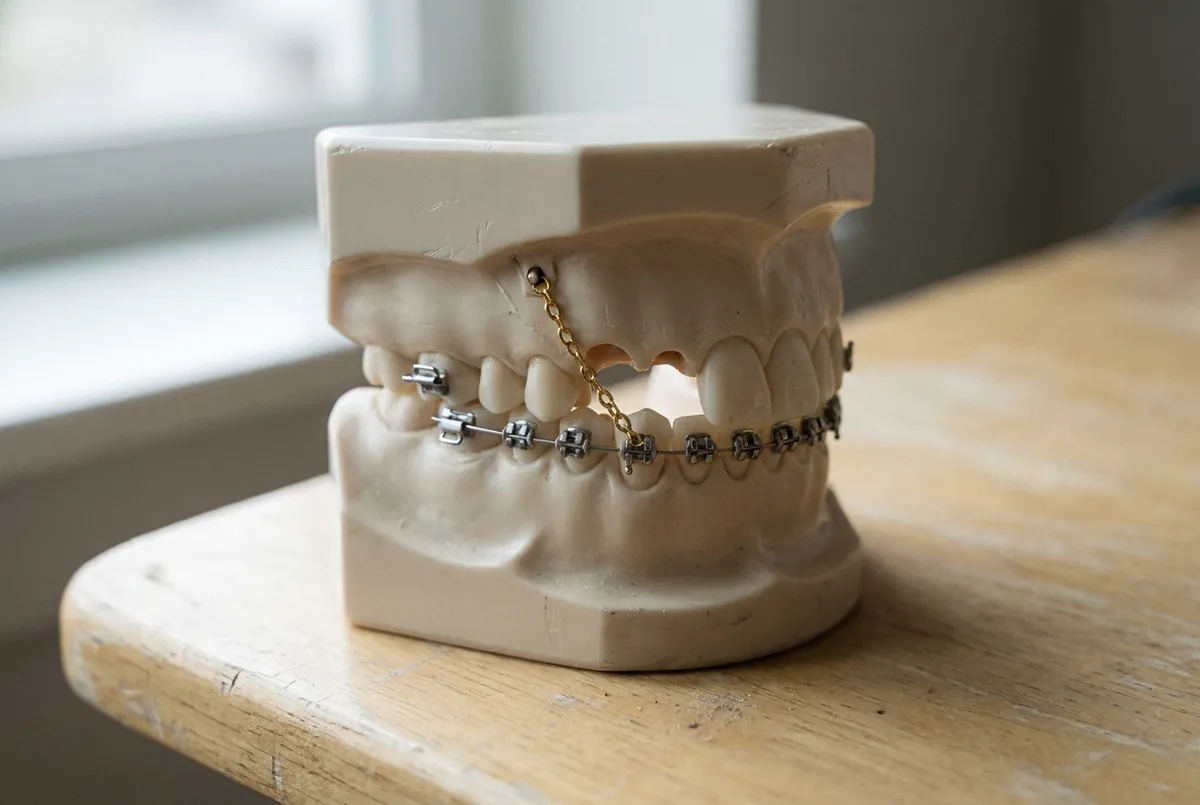
Closed exposure means the surgeon uncovers the crown, bonds a small bracket with a chain, and stitches the gum back so only the chain shows. Open exposure means the crown is left uncovered through a window in the gum. A 2018 meta-analysis of 8 studies found open exposure shortened alignment by about 2 months in the 2 studies that measured it; a 2026 meta-analysis of 6 studies found closed exposure hurt less on day 1. The 2018 authors note that their trials were few and small.
| What studies compared | Open exposure | Closed exposure |
|---|---|---|
| What is done | Gum window left open over the crown | Bracket and chain bonded, gum stitched back |
| Pain on day 1 | More | Less (2026 meta-analysis) |
| Time in surgery | Shorter | About 5 minutes longer (2026) |
| Time for the tooth to come in | About 2 months less alignment time (2018) and 3.4 months less eruption time (2026) | Longer |
| Tooth fused to bone | Lower odds in one small study (2018) | Higher odds in that study |
| Gum recession and complications | No clear difference (2026) | No clear difference (2026) |
How long does it take for an impacted canine to come down after surgery?
After exposure surgery, an impacted canine usually takes several months to a year to reach its place, and the orthodontist often starts a light pull within a couple of weeks. In the 2018 open versus closed exposure meta-analysis, initial alignment took 8.87 months on average for canines stuck toward the palate and 4.17 months for those toward the lip.
Position stretches the timeline. A 2021 systematic review in Orthodontics and Craniofacial Research (17 studies, 1,247 patients) linked a steeper tilt, a higher position and a position closer to the front teeth with longer treatment and less success, though its authors call that evidence limited. The parent timeline below puts the whole sequence in one place.
| Stage | Typical timing | What happens |
|---|---|---|
| First orthodontic check-up | By age 7 | An orthodontist checks how the adult teeth are developing (AAO) |
| Baby upper canines loosen | Ages 10 to 12 | The usual age they fall out (ADA) |
| Adult upper canine due | Ages 11 to 12 | Usual eruption age (ADA); a late one prompts an X-ray or 3D scan |
| Early step, if displaced | While some baby teeth remain | Baby canine may be removed, then rechecked for 12 months or more |
| Make room | Months before surgery | Braces open space for the canine |
| Exposure surgery | Once space is ready | Tooth uncovered, bracket and chain placed |
| Gentle pull | Often within a couple of weeks | Light, steady pull, checked at regular orthodontic visits |
| Tooth in line | Several months to a year | Palate-side canines take longer than lip-side canines (2018) |
Is impacted canine surgery possible as an adult?
Yes, adults can have impacted canine surgery, but the odds are lower and treatment takes longer. A 2003 study in the American Journal of Orthodontics and Dentofacial Orthopedics matched 19 adults who had palate-side impacted canines with teens whose canines were equally hard to reach: 69.5% of the adults' canines were brought into line, while every teen's canine was, and every failure was in a patient over 30.
The adults also needed more visits and more time to resolve the canine, though overall braces time was similar. That study is small and old, but its direction matches a 2025 systematic review in the Journal of Orthodontic Science, which found that age, canine position and angle, the side of the mouth and the technique used all affect treatment length. For a parent, the message is timing: a late canine noticed at 11 to 13 has more options than one found at 30.
Does an impacted canine need to be removed?
An impacted canine usually does not need to be removed if braces can move it. Saving the tooth is the aim, since an extracted canine has to be replaced later. Removal becomes the plan when the tooth is fused to the bone (ankylosed), sits where braces cannot bring it, or does not respond to the pull.
Leaving an impacted canine alone carries its own risk. A 2018 meta-analysis of 18 cone beam CT studies in the Journal of the American Dental Association linked impacted upper canines with root resorption, in which the canine wears away the roots of the incisors beside it. Slight resorption was the most common grade, but 30.9% of the resorption found was severe. The studies lacked control groups and follow-up, and the authors warn that delayed treatment may lead to resorption. If the canine will not move, this is the usual branch:
- The canine does not respond to the pull over the following visits.
- The surgeon and orthodontist check whether it may be fused to the bone.
- If it cannot be moved, removing it becomes the plan, through a surgical tooth extraction.
- The space is filled later; an implant usually waits until growth has finished, and a bridge is another option.
Does impacted canine surgery hurt?
Impacted canine surgery is done once the area is numb, so pressure rather than sharp pain is the usual sensation, and the spot stays sore for a few days. A 2026 meta-analysis of 6 studies and 450 patients found closed exposure caused slightly less pain on day 1 than open exposure, with no difference in the amount of pain medicine used.
Local numbing, alone or with laughing gas, is enough for many patients. IV sedation may fit better for a very nervous teen or a visit that uncovers both canines, and the choice is made with the patient and a parent at the consultation. Recovery from canine exposure, as the practice describes it, usually follows this pattern:
- First 24 hours: a little oozing and mild swelling; rest, and use gauze as your written instructions say.
- Days 2 to 3: the soreness settles; eat soft foods, use gentle warm salt water rinses and leave the chain alone.
- First week: most patients return to their usual routine; clean carefully around the chain.
- The months after: your orthodontist follows the tooth at regular visits.
What does canine exposure look like at Greater Atlanta Oral & Facial Surgery?
At Greater Atlanta Oral & Facial Surgery, teens referred by an orthodontist make up most canine exposure patients, though adults are seen as well. When needed, Dr. Abtin Shahriari takes a 3D cone beam CT scan to locate the canine and judge how near it sits to the neighboring roots, and he coordinates the surgery date with your orthodontist.
Canine exposure often goes through dental coverage, and some plans group it with orthodontic benefits; the practice works with most dental and medical insurance plans for surgical care. The impacted canine exposure page covers the surgery itself, and orthodontists and dentists can send a referral through the page for referring doctors.
- If your orthodontist refers you, bring the X-rays; a 3D scan is taken in the office when the case needs it.
- If the tooth looks movable, Dr. Abtin and your orthodontist settle when to operate and which way the tooth will be pulled.
- On surgery day, the crown is uncovered through a small gum opening, a tiny bracket is attached, and a thin chain from it is tied to the braces. A baby canine that is still in the way usually comes out at the same visit.
- Your orthodontist then starts a gentle pull on the chain, often inside two weeks.
- If the canine does not respond, it may have fused with the bone, and removal and a plan to fill the space later are discussed with you.
Questions to ask your surgeon
- Is the canine toward the palate or the lip, and how close is it to the incisor roots?
- Is removing the baby canine first worth trying at this age?
- Will you use open or closed exposure, and why?
- How long do you expect the pull to take for this position?
- What happens if the tooth has not moved after a few months?
- Which sedation option fits my teen?
When should you call the office right away?
After canine exposure, call the office if the chain comes off, bleeding has not slowed, or swelling is still increasing after day 3. Go to the ER or call 911 for trouble breathing or swallowing, swelling that moves toward the eye or into the neck, or a high fever. Both offices are open Monday to Friday, 7:00 AM to 5:00 PM.
Small questions are fine to ask too, such as whether a sore spot from the chain is normal. If your child's canine is late, or an X-ray shows it off course, you can request a consultation and bring your orthodontist's X-rays and notes to the first visit at the Atlanta (Buckhead) or Cumming office.
This guide is general information about oral surgery, not a diagnosis or a treatment plan. Your own options depend on an exam, your imaging and your health history, and they are set at your consultation. Contact the office with questions about your own care.