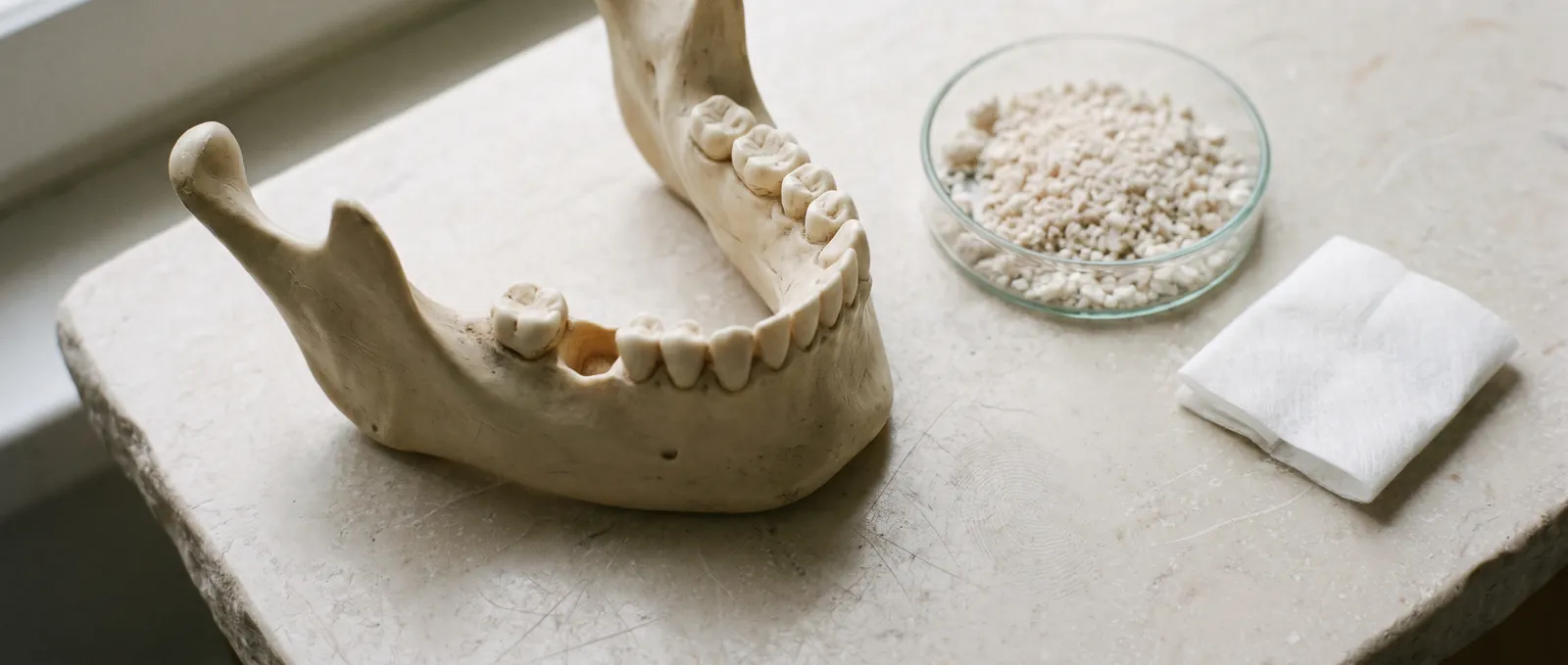
Is a bone graft required after an extraction?
No, a bone graft is not required after every extraction. A socket preservation graft is bone graft material packed into the empty socket on the day the tooth comes out, to limit how much the ridge shrinks as it heals. It matters most when you plan an implant there later, and much less when the gap will stay empty or the tooth was a wisdom tooth.
The 2019 consensus report of the XV European Workshop in Periodontology, built on four systematic reviews, named six considerations for planning the step from a tooth that must come out to an implant: infection at the site, whether an implant could be held firmly in the right position, a damaged socket, the thickness of the gum and bone, how much the look of the tooth matters to you, and your general health. Each of those comes from your tooth and your scan, not from a standard package.
That is why the replacement conversation belongs before a tooth extraction, not after it. A socket graft can only be placed while the socket is open, so the time to decide whether you want an implant, a bridge or nothing at all is the consultation before the tooth comes out.
What happens to bone and gums after a tooth extraction without a graft?
Without a graft, the socket fills in but the ridge around it shrinks, mostly in width. A 2012 systematic review of 20 human studies in Clinical Oral Implants Research found an average loss of 3.79 mm in width and 1.24 mm in height on the cheek side at 6 months, or 29 to 63 percent of the width and 11 to 22 percent of the height.
Most of that change happens early. The same review found 32 percent of the width already gone at 3 months, with rapid reductions over the first 3 to 6 months and slower change after that. AAOMS explains the reason in plain terms: a natural tooth keeps the bone around it stimulated, and once the tooth is gone that bone can be resorbed, which can make the area look sunken.
For a single tooth, the change you might notice is local: a dip in the gum line, most visible with a front tooth, and a narrower ridge where an implant would later go. If you are missing several teeth, the planning is different, and the single dental implants page is the place to start.
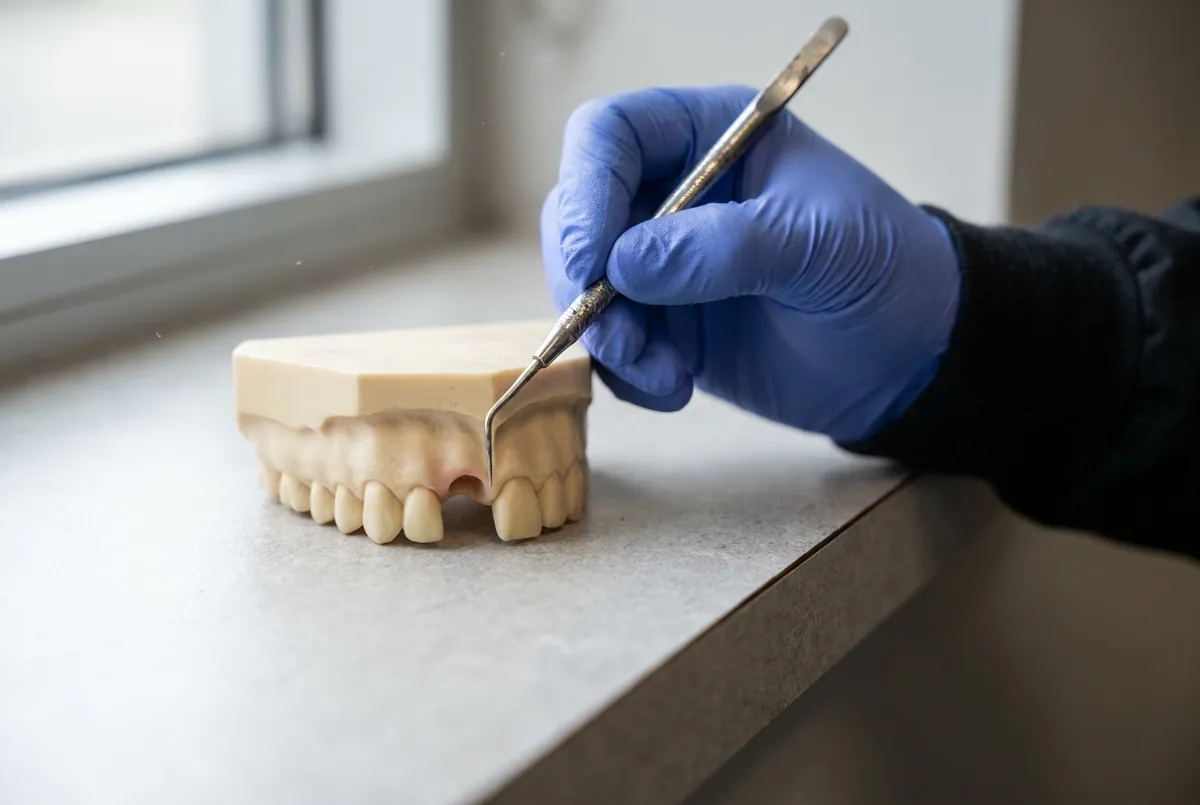
Is socket preservation worth it?
Socket preservation is most likely to be worth it when you plan an implant in that spot, especially for a front tooth or an implant that will wait months, and usually not for a wisdom tooth or a tooth removed for braces. A 2019 meta-analysis of 22 randomized trials in the Journal of Clinical Periodontology found grafted sockets kept about 2 mm (1.99 mm) more width than sockets left to heal alone.
A 2020 editorial in the Journal of the Korean Association of Oral and Maxillofacial Surgeons recommends the graft in visible areas, where bone loss is severe and when the implant will be delayed. In one subgroup analysis of the 2019 meta-analysis, the graft made a bigger difference where the outer socket wall was thicker than 1 mm (3.2 mm against 1.29 mm with a thinner wall). A cone beam CT scan shows that wall, which is one reason the decision is made from imaging rather than a rule of thumb.
| Your situation | Graft worth discussing? | Why |
|---|---|---|
| Front tooth, implant planned | Often yes | A dip in the gum shows when you smile, and the 2019 workshop lists appearance as a deciding factor |
| Back tooth, implant planned in a few months | Often yes | Most width loss happens in the first 3 to 6 months, before the implant goes in |
| Implant placed the same visit as the extraction | Not as a separate step | An implant can go straight in when the socket has no infection and enough firm bone |
| Damaged socket wall or infection at the root | More likely, and the plan may change | Both are among the six workshop factors |
| Wisdom tooth | Usually no | There is no tooth to replace |
| Tooth removed for braces | Usually no | The space is meant to close as teeth move |
| Bridge planned for a front tooth | Sometimes | Lost bone can leave a sunken look under the false tooth |
| No replacement planned | Usually no | The graft saves bone for an implant you do not plan to have |
What is the downside of a bone graft?
The main downsides of a socket graft are added cost, an extra healing step and evidence that is weaker than many websites suggest. The 2021 Cochrane review found that grafts of processed animal bone may reduce shrinkage by about 1.2 mm in width and 1.4 mm in height at six months, but rated that evidence very uncertain and found no proven difference in later grafting needs or implant failure.
So is it an upsell? Not in the right case, but it is not automatic either. A 2026 meta-analysis of 20 randomized studies in Oral and Maxillofacial Surgery found less width loss (1.37 mm) and height loss (1.18 mm) with ridge preservation, rated the certainty low, and concluded that the evidence does not establish universal indications or long-term implant, aesthetic or patient-reported benefit. A 2022 review in the British Dental Journal went further, questioning grafting as the default and reporting that many graft materials can delay natural bone healing.
Complications in grafting trials were usually minor. The Cochrane review noted that most trials described the procedure as uneventful, with occasional delayed healing, pain and swelling, membrane exposure or partial loss of graft material. Cleveland Clinic adds that graft failure is possible, especially in people who smoke or have certain medical conditions.
How long can you wait to get a bone graft after tooth extraction?
A socket preservation graft can only go in while the socket is fresh, so it is placed at the extraction visit. If you wait, the socket heals over and the question changes: a ridge that has already shrunk is rebuilt with ridge augmentation, which builds the ridge back out along its side or upper edge, either ahead of the implant or sometimes together with it.
Skipping the graft does not close the door on an implant. Many people with some bone loss can still have one, though a graft or a sinus lift may have to come first, and a 3D scan maps the thin spots. In the four trials of the 2021 Cochrane review that measured it, sites left to heal alone did not need extra bone at implant placement significantly more often than sites grafted with processed animal bone, although the trials were small.
Timing still matters. Because most shrinkage happens in the first 3 to 6 months, the longer a gap sits empty, the more likely an implant will need bone added first. If you are unsure whether you will want an implant, say so at the consultation so the choice is made with your scan and your plans.
How long does a tooth extraction with a bone graft take to heal?
A tooth extraction with a bone graft usually feels healed within one to two weeks, while the graft takes months to become bone. Cleveland Clinic puts initial recovery at about a week and graft healing at a minimum of three months, with larger grafts taking nine to 12 months. Your surgeon decides when the site is ready, often after a recheck and new imaging.
Most people find a socket graft little different from a plain extraction, because the graft goes into a socket that is already open. Ridge augmentation is a bigger step that usually means a few more days of swelling, one more reason the extraction-day decision matters.
- First 24 hours: keep your head up when you rest, hold cold packs to the cheek, and skip hot drinks, alcohol and straws.
- Days 2 to 3: swelling and tenderness tend to peak; stick to soft food and chew away from the graft.
- First week: finding a few gritty, sand-like grains in your mouth can be normal.
- Weeks 2 to 4: the stitches dissolve or come out, and gum tissue grows over the graft.
- Following months: the graft is slowly replaced by bone, and the site is checked, and sometimes scanned again, before an implant.
What not to do after a tooth extraction and bone graft?
After a tooth extraction and bone graft, do not poke the site with your tongue or fingers, chew on it, drink through a straw, smoke or rinse hard in the first days, because pressure and suction can disturb the clot and move graft granules. Call the office for bleeding that keeps going, swelling that is still growing after day 3, a fever, or more than a few granules of graft material coming out.
Go to the nearest emergency room or call 911 if you struggle to breathe or swallow, or if swelling travels toward your eye or down your neck. For pain or swelling that worries you, phone the Atlanta (Buckhead) or Cumming office between 7:00 AM and 5:00 PM, Monday to Friday; if you have pain or an emergency, every attempt will be made to see you that day. The after-surgery instructions page lists the general care steps.
- Do not smoke while the graft heals; Cleveland Clinic links smoking with a higher chance of graft failure.
- Do not chew hard food on that side until your surgeon says the site can take pressure.
- Do not panic over a few sand-like granules, but do call if a lot of material comes out.
- Do not skip the recheck before an implant, even when the gum looks fully healed.
What does socket preservation look like at Greater Atlanta Oral & Facial Surgery?
At Greater Atlanta Oral & Facial Surgery, the graft decision is made with your scan and your plans. Dr. Abtin Shahriari, the practice's only surgeon, studies the tooth on an X-ray, adds a cone beam CT scan when the roots or bone need more detail, and talks with you about replacing the tooth before it comes out.
Dr. Abtin spends most of a consultation listening, which matters when the honest answer is that a graft is optional in your case. Bring any notes or X-rays from your dentist, and use the contact page to book a consultation or send a question first.
- Replacement comes first in the conversation. If an implant is in your future, graft material can be placed in the socket at the extraction visit; if it is not, a graft is usually unnecessary and you can decline it.
- Dr. Abtin takes bone measurements from a cone beam CT scan, so a graft matches the spot where an implant would sit.
- When the socket has no infection and enough firm bone, the implant itself may be placed at the extraction visit; when it does not, the socket gets a graft and the implant waits until healing is done.
- Socket grafts are usually made from processed donor bone or another prepared material, not bone taken from you, so no second surgical site is needed. The gum is then closed, often with stitches that dissolve.
- Over the next months the site is checked again, and sometimes rescanned, before an implant goes in. If your dentist referred you, your dentist takes over restorative and routine care afterward.
Questions to ask your dentist or surgeon
- Do you expect me to want an implant in this spot, and when?
- Are the socket walls intact on my X-ray or scan?
- What would happen to my gum line if we skip the graft?
- If I skip it now, what would I need before an implant later?
- Which graft material and covering would you use, and why?
- Would the graft be part of my implant treatment plan, or a separate step?
This guide is general information about oral surgery, not a diagnosis or a treatment plan. Your own options depend on an exam, your imaging and your health history, and they are set at your consultation. Contact the office with questions about your own care.